
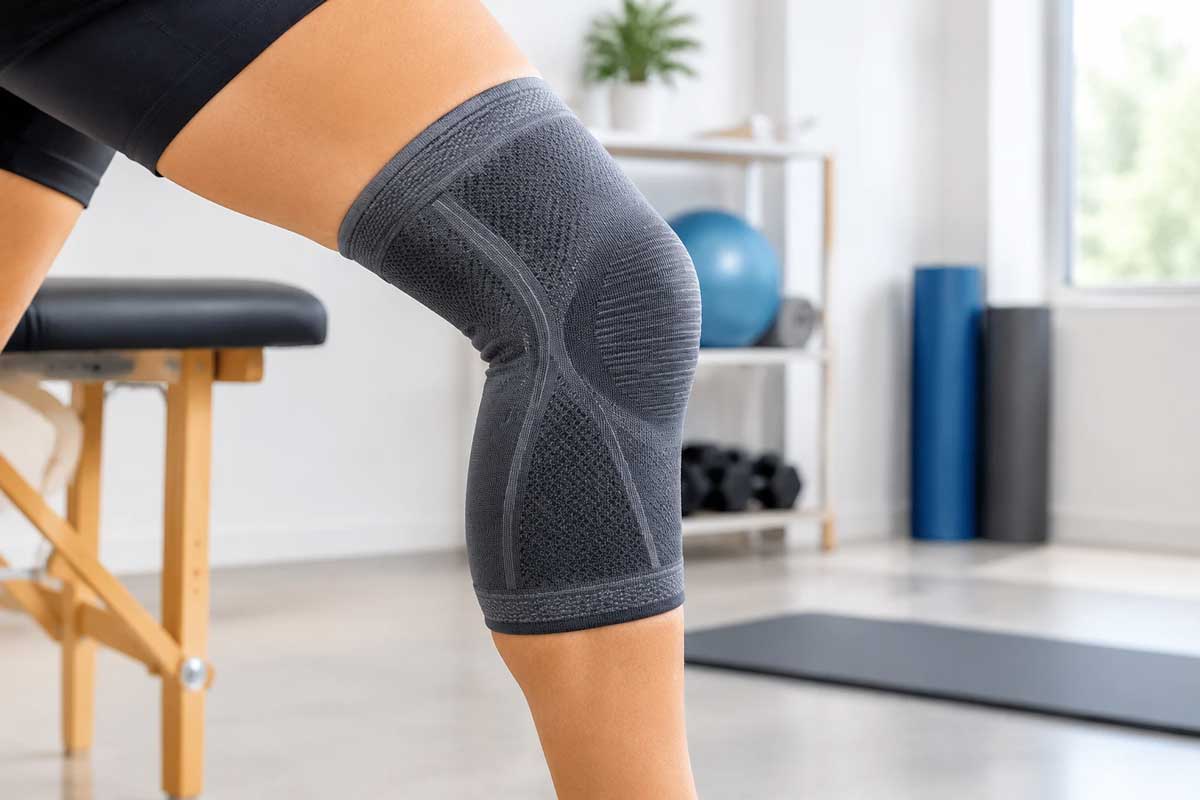
Compression Stocking for Knee Arthritis: What Helps?
Compression Stocking for Knee Arthritis: What Helps and Where GLA:D® Fits
If you have knee or hip osteoarthritis, you may have searched for a compression stocking hoping it could reduce pain, swelling, heaviness, or discomfort and help you move more comfortably. It is an understandable question. When your knee is sore and your legs feel tired, the idea of putting on something supportive and getting on with your day sounds pretty appealing.
But there is an important distinction to make.
A compression stocking can be useful for certain circulation-related problems and some types of lower-leg swelling. It is not, by itself, a treatment that reverses osteoarthritis or rebuilds damaged cartilage. For people with knee or hip osteoarthritis, current evidence places much more emphasis on education, regular physical activity, strengthening, movement training, and self-management.
This is exactly where the GLA:D® Canada Program for Knee & Hip Osteoarthritis can become relevant.
At Sync Move Rehab Centre, the GLA:D® Canada Program combines education with supervised exercise to help people with knee and hip osteoarthritis manage pain, improve movement, build strength, and stay active. The program is designed around the idea that an arthritic joint does not automatically mean that movement should disappear from your life.
In fact, one of the most useful things you can learn about osteoarthritis is that moving less is not always the answer.
And no, your knee does not need to be wrapped in bubble wrap for the rest of your life.
What Is a Compression Stocking?
A compression stocking is a specially designed garment that applies pressure to the leg.
The pressure can help support blood flow from the lower leg back toward the heart. Compression garments are commonly used for conditions involving the veins, such as certain types of chronic venous disease, varicose veins, and leg swelling.
The amount of pressure varies between products. Some are relatively light, while medical compression garments can provide substantially greater pressure.
This is important because more compression is not automatically better.
The appropriate type and level of compression depend on why the person needs it, their circulation, the condition of their skin, the shape of their leg, and other health factors.
For people with circulation problems, compression can be an important part of management. A 2025 clinical practice guideline on chronic venous disease, for example, suggests compression therapy for people with symptomatic varicose veins, although the certainty of evidence varies.
However, that evidence should not be confused with evidence that compression stockings treat osteoarthritis itself.
Can a Compression Stocking Help Knee Osteoarthritis?
The short answer is:
Sometimes it may help with a related symptom, but it should not be considered a primary treatment for osteoarthritis.
Osteoarthritis is a condition involving the joint. It can cause pain, stiffness, reduced strength, and difficulty with activities such as walking, climbing stairs, standing from a chair, or getting in and out of a car.
A compression stocking works differently.
It applies pressure to the limb and is primarily used for circulation and swelling-related problems. It does not directly strengthen the muscles around the knee, improve movement control, or teach you how to manage osteoarthritis.
This distinction matters.
Imagine your knee is a car that has started making an unpleasant noise.
Putting a compression stocking on your leg might be a little like improving something around the wheel. That may be useful if there is a separate problem there. But it does not automatically repair the engine.
For osteoarthritis, the “engine work” includes appropriate exercise, strength training, movement education, and long-term self-management.
Why Exercise Matters More Than Many People Realize
One of the biggest misconceptions about knee arthritis is that exercise will simply “wear out” the joint faster.
For many people with osteoarthritis, the opposite approach is more helpful.
Major clinical guidelines recommend exercise as a central part of non-surgical osteoarthritis management. The American College of Rheumatology and Arthritis Foundation strongly recommend exercise for people with knee and hip osteoarthritis.
OARSI guidelines similarly identify structured land-based exercise and arthritis education as core treatments for knee osteoarthritis, with structured exercise also considered a core treatment for hip osteoarthritis.
Why?
Because the muscles around your joints matter.
Stronger and better-controlled muscles can help you perform everyday movements more effectively. Exercise can also improve physical function, confidence, balance, and general fitness.
That does not mean everyone with arthritis should suddenly start doing heavy squats with a barbell.
The right exercise needs to match the individual.
This is one reason supervised rehabilitation can be useful.
What Is GLA:D® Canada?
GLA:D® stands for Good Life with osteoArthritis in Denmark.
The program was originally developed in Denmark and later adapted for use in Canada. It is designed specifically for people with knee and hip osteoarthritis.
The Canadian program has three major elements:
- Education about osteoarthritis
- Supervised exercise
- Monitoring of outcomes
The official GLA:D Canada program describes the approach as a standardized education and exercise program for people with hip and knee osteoarthritis.
At Sync Move Rehab Centre, the program includes an initial physiotherapy assessment followed by education sessions and supervised neuromuscular exercise sessions.
The Sync Move program page explains that participants typically complete 2–3 education sessions and 12 supervised exercise sessions, with exercise sessions lasting about 60 minutes and taking place twice a week over six weeks.
That structure is important.
Rather than simply telling someone, “You have arthritis, so go exercise,” the program teaches people how and why movement can help.
What Happens During GLA:D® Canada?
1. You start with an assessment
Before jumping into exercise, a qualified professional assesses whether the program is appropriate for you.
At Sync Move Rehab Centre, the GLA:D® journey begins with a comprehensive physiotherapy assessment.
This allows the therapist to understand your symptoms, movement limitations, functional abilities, and goals.
That matters because two people can both have knee osteoarthritis while having completely different problems.
One person may struggle with stairs.
Another may have difficulty getting out of a chair.
Someone else may be avoiding walks because they are afraid their knee will suddenly become worse.
The exercise plan should reflect the person, not just the diagnosis.
2. You learn about osteoarthritis
Education is a major part of GLA:D®.
You learn about topics such as:
- What osteoarthritis actually is
- Common symptoms
- Available treatment options
- How exercise can help
- How to manage symptoms
- How to handle everyday activities
- How to remain physically active
This can be surprisingly important.
When people do not understand osteoarthritis, it is easy to become afraid of movement.
A little knee pain can turn into:
“Maybe I should stop walking.”
Then:
“Maybe I should stop exercising.”
Then:
“Maybe I should avoid stairs.”
Eventually, normal daily movement becomes increasingly difficult.
Education can help break that cycle.
3. You perform supervised exercises
The exercise portion of GLA:D® focuses on neuromuscular control, strength, and functional movement.
At Sync Move Rehab Centre, exercises are individually modified according to your abilities, fitness level, and symptoms.
That means you are not expected to perform exactly the same exercise in exactly the same way as everyone else.
Your neighbour’s knee is not your knee.
Your hip is not your neighbour’s hip.
And your body certainly did not read the same instruction manual.
What Does the Research Say About GLA:D®?
This is where the program becomes particularly interesting.
A large international analysis involving 28,370 people with symptomatic knee or hip osteoarthritis looked at outcomes after participating in GLA:D® in Denmark, Canada, and Australia.
Researchers found improvements of approximately:
- 26–33% in average pain intensity
- 8–12% in walking speed
- 18–30% in chair-stand ability
- 12–26% in joint-related quality of life
The researchers also found that approximately 43–47% of participants experienced a clinically relevant reduction in pain.
Those numbers do not mean everyone will experience the same improvement.
They also do not mean GLA:D® “cures” osteoarthritis.
What they suggest is that structured education and exercise can produce meaningful improvements for many people.
What Do Canadian GLA:D® Results Show?
The Canadian program has also collected substantial outcome data.
According to GLA:D Canada, its 2023 results showed that:
- 55.8% of hip participants reported improved pain
- 58.3% of knee participants reported improved pain
- 51% of hip participants reported improved function
- 56.4% of knee participants reported improved function
- 57.6% of hip participants reported improved quality of life
- 64.4% of knee participants reported improved quality of life
By 2023, the program had trained 2,015 clinicians, and 402 sites had launched across nine provinces and two territories.
GLA:D Canada has also continued to grow. The official program website now lists a 2024 Annual Report, reflecting the ongoing expansion and evaluation of the program.
These figures are useful because they come from a real-world program rather than only a small laboratory study.
Does GLA:D® Replace a Compression Stocking?
No.
And a compression stocking does not replace GLA:D® either.
They address different problems.
A person with osteoarthritis might also have another condition that causes lower-leg swelling or circulation problems. In that situation, a healthcare professional may recommend compression.
But if the main issue is knee osteoarthritis, compression should not distract from the treatments that have stronger evidence for osteoarthritis management.
Think of it as a toolbox.
A compression stocking can be one tool.
Exercise can be another.
Education is another.
Medication, weight management when appropriate, braces, walking aids, injections, or surgery may be considered in other situations.
The goal is not to find one magical item that solves everything.
Unfortunately, medicine has not yet invented the “one sock to fix all problems.”
What About Knee Swelling?
Swelling deserves special attention because it can have different causes.
Some people with knee osteoarthritis experience swelling around the joint.
But swelling in the lower leg can also have other causes, including venous problems, medication effects, lymphatic problems, injury, or other medical conditions.
That distinction matters.
Compression therapy is commonly used to manage certain forms of lower-extremity edema and venous disease. Recent vascular guidance supports compression for appropriate patients with symptomatic venous disease.
There has also been research into compression-based treatments for knee swelling.
For example, one randomized controlled trial involving 89 people with knee osteoarthritis found that intermittent pneumatic compression, when added to conventional treatment, produced better results for knee swelling than the comparison treatment involving cold packs.
However, intermittent pneumatic compression is not the same thing as wearing an ordinary compression stocking.
That distinction should not be lost.
A more recent randomized trial published in 2026 found that short-term elastic compression bandaging was not clinically superior to sham or no bandaging for pain or physical function in people with knee osteoarthritis.
So the evidence does not support telling every person with knee arthritis:
“Buy a compression stocking and your knee will feel better.”
That would be far too simplistic.
When Should You Be Careful With Compression?
Compression garments are not appropriate for everyone.
Certain circulation problems can make compression unsafe or require professional assessment before it is used.
For example, clinical guidance warns against inappropriate use of anti-embolism stockings in people with suspected or confirmed peripheral arterial disease, certain forms of neuropathy, fragile skin, severe leg edema, and other conditions.
Evidence-based consensus guidance also identifies severe arterial circulation problems, some cases of severe heart failure, advanced neuropathy, fragile skin, and other situations as reasons for caution or avoidance.
That is why choosing a compression stocking should not always be treated like choosing a pair of socks at the shopping mall.
If you have significant swelling, circulation problems, diabetes, numbness, wounds, unexplained leg pain, or other medical concerns, ask an appropriate healthcare professional before using compression.
Why “Rest More” Is Not Always Good Advice for Arthritis
Many people with osteoarthritis gradually become less active because movement hurts.
It makes sense.
If walking hurts, you walk less.
If stairs hurt, you avoid stairs.
If standing hurts, you sit more.
But over time, reduced activity can create another problem: muscles become weaker and daily activities become harder.
This can create a frustrating cycle:
Pain → less movement → weakness → reduced confidence → even less movement.
GLA:D® takes a different approach.
The goal is to help people understand their condition and learn ways to move safely and progressively.
The Sync Move Rehab Centre program specifically includes progressive strengthening, balance and movement training, and functional exercises related to everyday activities.
Can Exercise Make Osteoarthritis Worse?
Exercise can sometimes cause temporary discomfort, particularly when someone is starting or changing an exercise program.
That does not automatically mean the exercise is damaging the joint.
However, exercise should be appropriately selected and progressed.
This is another reason professional guidance can be valuable.
The American College of Rheumatology notes that a broad range of exercise options can benefit people with osteoarthritis and that supervised exercise tends to produce better outcomes than simply telling someone to exercise on their own.
The key is finding the right amount and type of activity for the individual.
What About Weight and Knee Osteoarthritis?
Weight is another part of the conversation, although it should always be handled respectfully.
For people with knee or hip osteoarthritis who are overweight or living with obesity, clinical guidelines strongly recommend weight loss as part of management.
The ACR/Arthritis Foundation guideline notes that even weight loss of 5% or more of body weight can be associated with improvements, with greater benefits generally seen with greater weight loss. Exercise can enhance the benefits of weight management.
This does not mean someone needs to reach a “perfect” weight before exercising.
Quite the opposite.
Exercise and appropriate nutrition can work together.
Why Staying Active Matters in Canada
Osteoarthritis is not a minor issue affecting only a small group of older adults.
Arthritis affects more than 6 million people in Canada, according to Arthritis Society Canada, which describes arthritis as Canada’s most common chronic disease.
Canada’s health system also sees a significant burden related to knee osteoarthritis.
According to the Canadian Institute for Health Information, 65,252 hospitalizations for knee osteoarthritis were recorded in 2023–2024, making knee osteoarthritis one of the top five reasons for hospitalization that year.
And when arthritis eventually becomes severe enough to require joint replacement, the numbers become even more significant.
CIHI reported 175,242 hip and knee replacement procedures in Canada in 2024–2025, a 26.5% increase compared with 2019–2020.
These numbers do not mean everyone with osteoarthritis will need surgery.
They do, however, highlight why effective non-surgical management matters.
Can GLA:D® Help You Delay Joint Replacement?
GLA:D® is not a guarantee that someone will avoid surgery.
That promise would go far beyond the evidence.
However, helping people manage symptoms, maintain strength, improve physical function, and remain active may be an important part of living well with osteoarthritis.
At Sync Move Rehab Centre, the program is suitable for people with early through advanced knee or hip osteoarthritis, with the therapist determining whether it is appropriate during the assessment.
The aim is not to tell someone, “You must never have surgery.”
Instead, it is about helping you understand your options and make informed decisions about your health.
What Makes GLA:D® Different From Simply Exercising at Home?
You might reasonably ask:
“If exercise helps, why can’t I just find some knee exercises on YouTube?”
Fair question.
You can certainly find exercises online.
The problem is that information is not the same thing as an individualized program.
A structured GLA:D® program provides:
- An initial assessment
- Education about osteoarthritis
- Supervised exercise
- Progressive strengthening
- Movement training
- Functional exercises
- Progress monitoring
- Professional guidance
The official GLA:D Canada program is standardized, with certified providers expected to deliver its core components.
At Sync Move Rehab Centre, the exercises are adapted to the participant’s abilities and symptoms rather than treating everyone as if they have the exact same knee.
What Should You Do If You Have Knee Pain and Leg Swelling?
Start by figuring out what is actually causing the symptoms.
That sounds obvious, but it is easy to assume:
“I have arthritis, therefore every symptom must be arthritis.”
Not necessarily.
If you have knee pain, stiffness, difficulty walking, trouble with stairs, or difficulty getting out of a chair, an assessment with an appropriate healthcare professional can help determine what is happening.
If you also have significant lower-leg swelling, heaviness, skin changes, numbness, or circulation concerns, those symptoms deserve separate consideration.
A compression stocking might be appropriate for one problem while exercise and rehabilitation are needed for another.
The two ideas are not necessarily competing.
They simply have different jobs.
Is the GLA:D® Canada Program Right for You?
The program may be worth discussing with a physiotherapist if you have:
- Knee osteoarthritis
- Hip osteoarthritis
- Pain while walking
- Difficulty climbing stairs
- Morning stiffness
- Difficulty standing from a chair
- Reduced balance
- Reduced mobility
- Fear of movement because of arthritis
- Difficulty staying physically active
Sync Move Rehab Centre notes that GLA:D® can be suitable for people with mild, moderate, and severe knee or hip osteoarthritis, subject to assessment.
In many cases, a physician referral is not required, although requirements can vary depending on the healthcare provider and insurance arrangement.
What If You Already Wear Compression Stockings?
If a healthcare professional has already recommended compression stockings for you, there is generally no reason to assume that participating in an appropriate osteoarthritis exercise program automatically conflicts with their use.
However, your therapist should know about any compression garment or other medical treatment you are using.
The important question is not:
“Compression stocking or exercise?”
It may actually be:
“What combination of treatments makes sense for my specific situation?”
That is a much better question.
Frequently Asked Questions
Can compression stockings reduce knee arthritis pain?
Compression stockings are not considered a primary treatment for osteoarthritis pain. They may help certain circulation-related symptoms or swelling, but evidence does not support using ordinary compression stockings as a standalone treatment for knee osteoarthritis.
Are compression stockings good for swollen legs?
They can be helpful for some causes of lower-leg swelling, particularly certain venous conditions. However, swelling can have many causes, and compression is not suitable for everyone. A healthcare professional can help determine whether compression is appropriate.
Does GLA:D® use compression stockings?
Compression stockings are not the core of the GLA:D® Canada program. GLA:D® focuses on education and supervised exercise for people with knee and hip osteoarthritis.
What exercises are included in GLA:D®?
The program includes supervised neuromuscular exercises, strengthening, balance and movement training, and functional exercises designed to relate to everyday activities. Sync Move Rehab Centre individually modifies exercises according to each participant’s abilities and symptoms.
How long does GLA:D® Canada take?
The standard program includes education and supervised exercise. At Sync Move Rehab Centre, the program is described as including 2–3 education sessions and 12 supervised exercise sessions, with exercise sessions held twice weekly over six weeks.
Can I exercise if I have severe knee osteoarthritis?
Many people with severe osteoarthritis can still benefit from appropriately selected exercise. The right program depends on your symptoms, health, mobility, and other conditions. A professional assessment can help determine what is appropriate.
Can GLA:D® cure osteoarthritis?
No. GLA:D® does not cure or reverse osteoarthritis. It is designed to help people manage symptoms, improve function, and stay active.
Do I need surgery if I have knee osteoarthritis?
Not necessarily. Osteoarthritis can often be managed with non-surgical strategies such as education, exercise, weight management when appropriate, and other treatments. Surgery may be considered when symptoms remain severe despite appropriate non-surgical management.
The Bottom Line: Compression Stocking vs. GLA:D® for Osteoarthritis
A compression stocking can be useful for certain circulation-related conditions and types of lower-leg swelling, but it should not be viewed as a cure or primary treatment for knee or hip osteoarthritis. The latest evidence and major clinical guidelines continue to place education, exercise, strengthening, physical activity, and self-management at the centre of non-surgical osteoarthritis care. GLA:D® Canada puts these principles into a structured program that helps people understand their condition and learn how to move with greater confidence. Research involving tens of thousands of participants has shown meaningful improvements in pain, walking ability, physical function, and quality of life, while Canadian program data also show positive outcomes among many participants. If knee or hip osteoarthritis is making everyday life harder, Sync Move Rehab Centre offers the GLA:D® Canada Program for Knee & Hip Osteoarthritis to help you take a practical, evidence-based approach to managing your condition. Visit Sync Move Rehab Centre at https://syncmove.ca/ to learn more about the program, explore rehabilitation services, and take the next step toward moving better and staying active.
References
- GLA:D Canada — Results in Canada
Canadian program results, clinician training, locations, pain, function and quality-of-life outcomes. - GLA:D Canada — What Is GLA:D Canada?
Overview of the Canadian program, including education, exercise and outcome monitoring. - GLA:D Canada — Education and Exercise
Information about the education and exercise components of the GLA:D® program. - GLA:D Canada — How to Participate in GLA:D Canada
Information about eligibility, assessment, referrals and participation. - Roos et al. — Immediate outcomes following the GLA:D® program in Denmark, Canada and Australia
Large longitudinal analysis involving 28,370 people with symptomatic knee or hip osteoarthritis. - McGlasson et al. — The GLA:D® Canada program for knee and hip osteoarthritis
Canadian program registry and participant data from the early implementation period. - GLA:D Canada — Canadian Program and Implementation Research
Background on the Canadian adaptation, implementation and development of GLA:D®. - American College of Rheumatology / Arthritis Foundation — 2019 Guideline for the Management of Osteoarthritis
Evidence-based recommendations for the management of knee and hip osteoarthritis. - OARSI — Guidelines for the Non-Surgical Management of Knee, Hip and Polyarticular Osteoarthritis
International evidence-based recommendations for non-surgical osteoarthritis management. - Canadian Institute for Health Information — Hip and Knee Replacements in Canada, 2024–2025
The latest Canadian statistics on hip and knee replacement procedures. The 2024–2025 report records 175,242 hip and knee replacements in Canada, 5.3% more than the previous year. - Arthritis Society Canada — What Is Arthritis?
Current Canadian information about arthritis prevalence, symptoms and impact. Arthritis Society Canada reports that more than 6 million Canadians live with arthritis. - Arthritis Society Canada — About Arthritis
Canadian public-health information and resources about arthritis and living with the condition. - Society for Cardiovascular Angiography & Interventions — 2025 Clinical Practice Guidelines for Chronic Venous Disease
Current clinical guidance concerning chronic venous disease and compression therapy. - Indications for Medical Compression Stockings in Venous and Lymphatic Disorders — Evidence-Based Consensus Statement
Evidence concerning the indications, benefits, precautions and contraindications of medical compression stockings. - Canadian Institute for Health Information — Joint Replacement
Current Canadian information on hip and knee replacement procedures, outcomes and healthcare trends. - Canadian Institute for Health Information — Wait Times for Priority Procedures in Canada
Canadian data on hip and knee replacement volumes and access to surgery.